
Every Role but Author: Directing AI Agents on Mission-Critical Infrastructure
AI disclosure: I wrote this article. Claude, ChatGPT, Gemini and Grok reviewed drafts, and I accepted some of their edits. Claude also checked facts against the project record and drew the figures.
MobilSense Technologies recently migrated MobilSentry, its flagship wireless management product, from a collection of leased hardware in a data center to AWS. The objective of the effort was to establish GitOps against an infrastructure-as-code control plane for the full lifecycle of the platform. The first measure of success was the migration of all systems on a legacy, host-centric configuration to a cloud-native platform designed to align with the AWS Well-Architected Framework.
The stakes for this migration were high because we had limited rollback options. We started the migration on Saturday of Labor Day weekend to give us an additional day should we need to roll back and take a second run at the migration. Beyond that, the grip of time would grow tighter with each passing day as our hosting provider was closing the data center in which we were hosted, and our contract with them ended on 13 September, the Sunday following Labor Day.
The migration was uneventful, with just over 6 hours of customer-facing outage, comfortably within the planned window of 12 hours. The long pole in the tent was the migration of hundreds of Postgres databases. If our business weren't on the line, it would be reasonable to characterize the migration as boring. That it went that way was by design, and the reasons grow out of a foundation that was established five months earlier, in April.
MobilSentry began serving customers in 2005. As business grew, the platform grew through the addition of hosts. The configuration was managed following commonly accepted practices for the time. These practices were based on manual administrative tasks supported by open-source and homegrown tools.
This migration had been anticipated for a number of years. We had planned to complete the migration in Q4 of 2026, and started the year with that intention. Early in the year, our hosting provider was acquired. During our getting-to-know-you call with the new provider, we told them of our plans to migrate out by Q4. They pressured us to be complete by the end of October.
Our platform development commenced on 6 April 2026 with a team of one. I was responsible for what was built: architect, business analyst, project manager, reviewer of record, release manager, and, on the night of the migration, operator. I rounded out the team with AI agents that drafted, implemented, and reviewed under my direction. Agents authored every work product.
Rigor Before Load
I required every change to move the system from one known state to another by a difference that was well defined and verifiable. The vehicle to accomplish this was a statement of work (SOW) for each change.
I configured three types of agents: analyst, implementer, and reviewer. I established rules for treatment of reviewer feedback, and no work product advanced until the review process was completed. This level of rigor was a guiding principle for the project, and was specifically captured in the role definition that framed every SOW: "The rigor is not a response to current external load. It is the discipline we want in place before external load exists."
The primary work products, Terraform code and related configuration files, are the infrastructure-as-code control plane for the platform. The full lifecycle of the platform is managed through a GitOps methodology that includes a manual approval gate for which I am responsible. Every change is tracked in the repository.
Resources and the workflows that they enable are instrumented with monitors, alarms, backup, and operational tooling as appropriate to manage them over their full lifecycle. For compute resources this may include the ability to destroy and relaunch the resource while preserving the continuity of its configuration. Building these supporting aspects enabled an accurate assessment of operational readiness without overlooking essential behind-the-scenes elements of the platform.
Six Weeks Vanish
A month into our project, we were contacted by the new hosting provider with bad news. Their schedule to shut down the data center had changed, and we were to be out by the middle of September. We were not in a position of leverage, and the net of this change was that we lost six weeks of our platform implementation and operational readiness preparation time. We set Labor Day weekend as the scheduled migration date and agreed to a meeting after the middle of July to confirm that we were on schedule.
In mid-July, I considered contingency plans that we could implement. None were very appealing. I had developed a high level of confidence in both the platform and the process that had produced it. Over three months, the agents had demonstrated their ability to deliver quickly and correctly. I had an operational system that I could assess against the full set of requirements. I was confident in the ability to go live with the core of MobilSentry, but less confident that every incidental workflow would be ready. I made a calculated decision: we would prioritize incomplete workflows and fill the gaps with interim solutions until each workflow was fully supported. With this in mind, I notified the hosting provider that we were still on track for the Labor Day migration.
Trust Through Gates
Every change passed through five gates, and I controlled each one:
- Authoring. I set the objective and dispatched an analyst agent to write the SOW: what to build, not how, with acceptance criteria. A separate agent reviewed it until no actionable findings remained. I consider these the most valuable reviews in the process.
- Implementation. Only a reviewed SOW could be dispatched to an implementation agent, whose work went through the same review loop before a pull request was opened.
- Merge. I approved and merged every pull request based primarily on my review of the agents' review. I resolved any concerns with the implementation agent before merging.
- Deployment. I ran the pipeline and approved each apply at the manual gate.
- Validation. I confirmed the acceptance criteria were met before the SOW was marked validated.
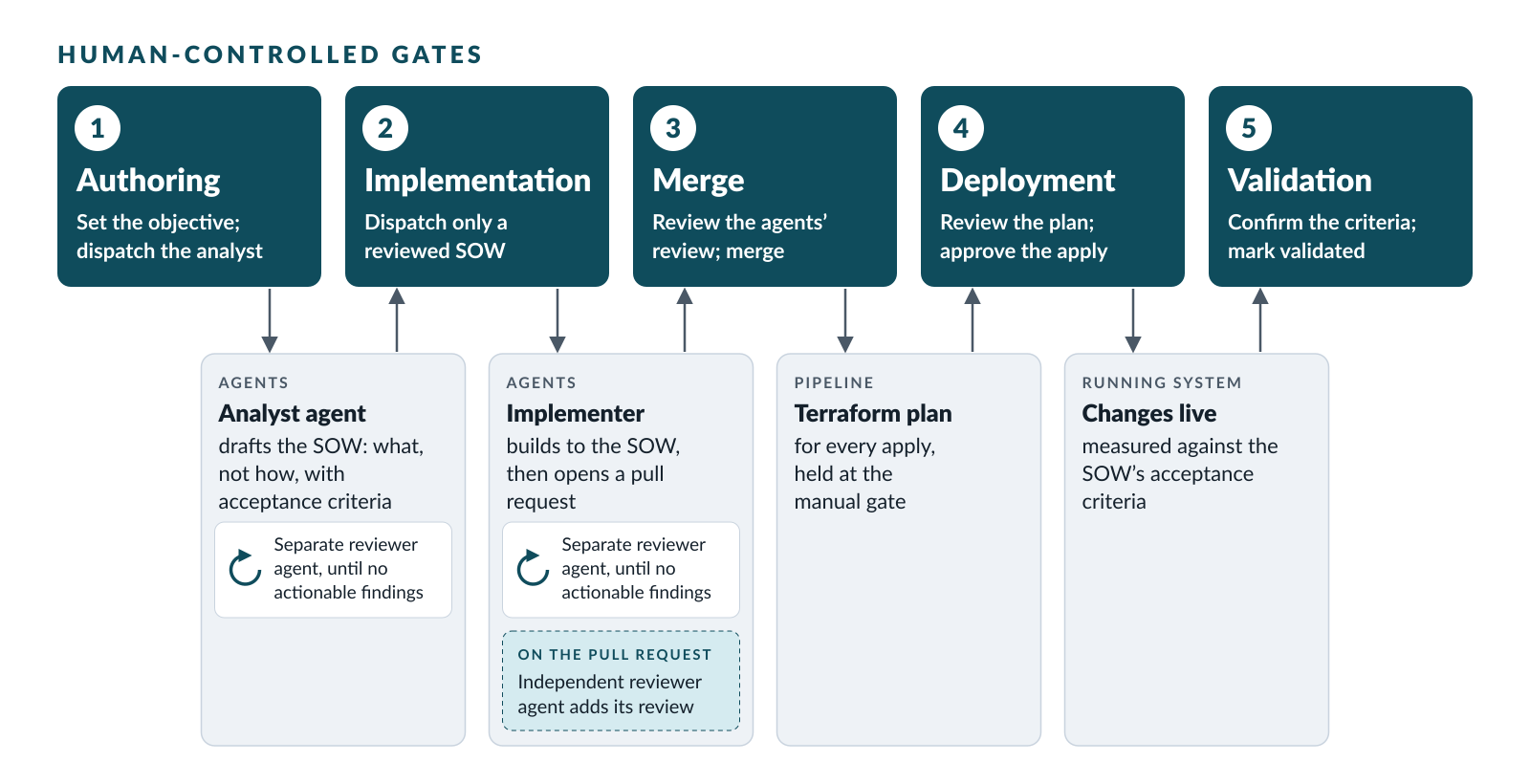
The gates were sequential for each SOW, but not for me. Where dependencies allowed, I kept several SOWs moving at once, each with its own agents, at times as many as 10. The pace was the agents'. Staying on target was up to me.
When the migration started, the record showed:
- 424 SOWs closed, 7 pending validation.
- 410 pull requests reviewed and merged in the core repository; work for other repositories is not included in this number.
- 520 pipeline executions, none applied without my approval.
- 4,825 commits, every one made at my direction or as directed by our development process.
- 1,581 managed AWS resources.
This was an objective-driven project with real constraints, breaking new ground. That there were strains was to be expected. The bastion configuration grew from 4 planned SOWs to 78. Each strain became tracked work through the same gates. When the strains surfaced weaknesses in the process, I updated the agent instructions, and the process became stronger.
Turned Loose or Reined In
Methods of applying AI to software solutions fit on a spectrum from turning agents loose to see what they produce, to managing them closely. One common concern about close management is that the advantage of agents is lost because human review of agent-produced code becomes the bottleneck. That concern is reasonable.
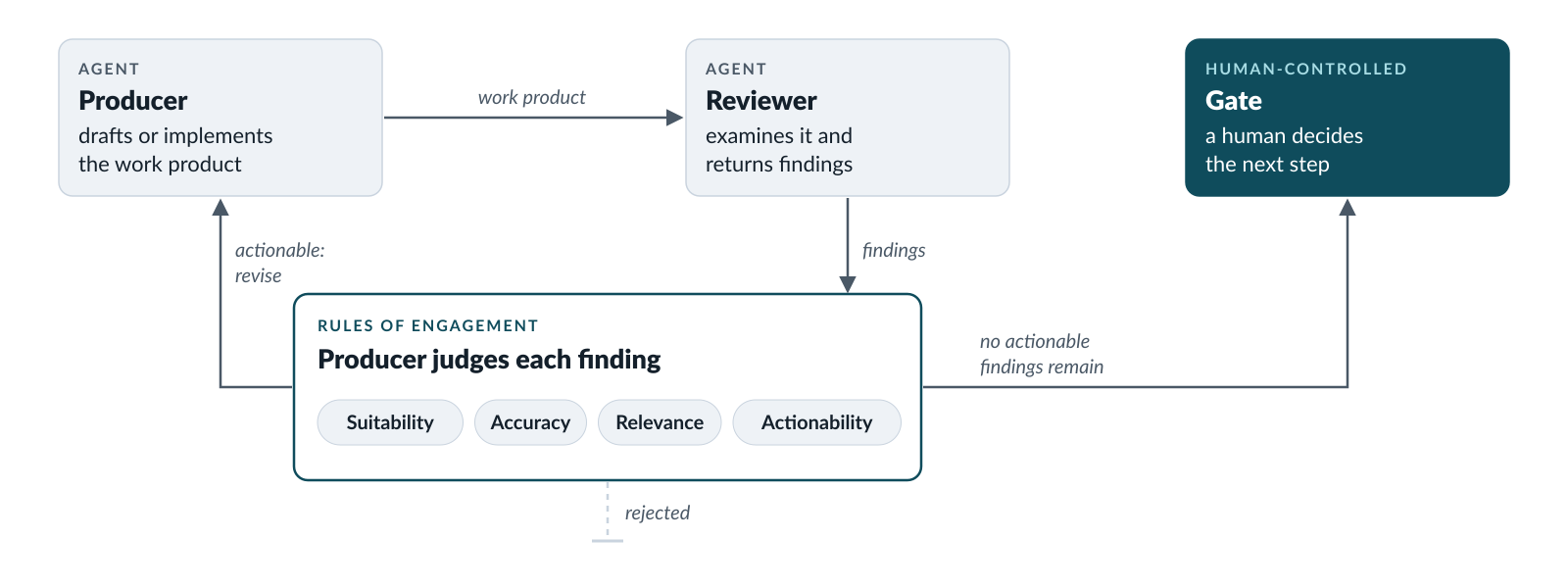
The review process stands on two pillars. The first pillar is that agents need rules of engagement for reviewer feedback. The second pillar is that humans primarily review the agents' well-structured reviews. I delegated examination, not accountability.
Agents that produce work products judge each reviewer finding on four criteria: suitability, accuracy, relevance, and actionability. Actionable findings meet those four criteria. The rest are rejected, and the review process continues until there are no actionable findings. Agents reviewing agents may share blind spots. The deployment and validation gates mitigate this through independent lines of sight: human review of the Terraform plan and objective acceptance criteria applied to the running system.
Where a project is placed on the spectrum should depend on the blast radius of failure. A defect in a new application can be confined to the application. A defect in mission-critical infrastructure can disrupt everything that it supports.
At 17:00 on the evening of the cutover, I launched the pipeline to tear down the test hosts ahead of launching their production versions. This was execution 521 of the pipeline. My review of the Terraform plan surfaced an error that excluded some of the hosts. I aborted the run at 17:06. Six minutes later, execution 522 was launched with the correction and the migration was under way.
By Labor Day Monday, the system had been fully migrated and operational for more than 24 hours. End-to-end testing that had previously not been possible surfaced two failing interfaces. Those were fixed the same day using the established process.
The process that we established supports the full lifecycle of the platform; it was not abandoned after the migration. AI made possible the scale within the deadline. The discipline made it trustworthy.